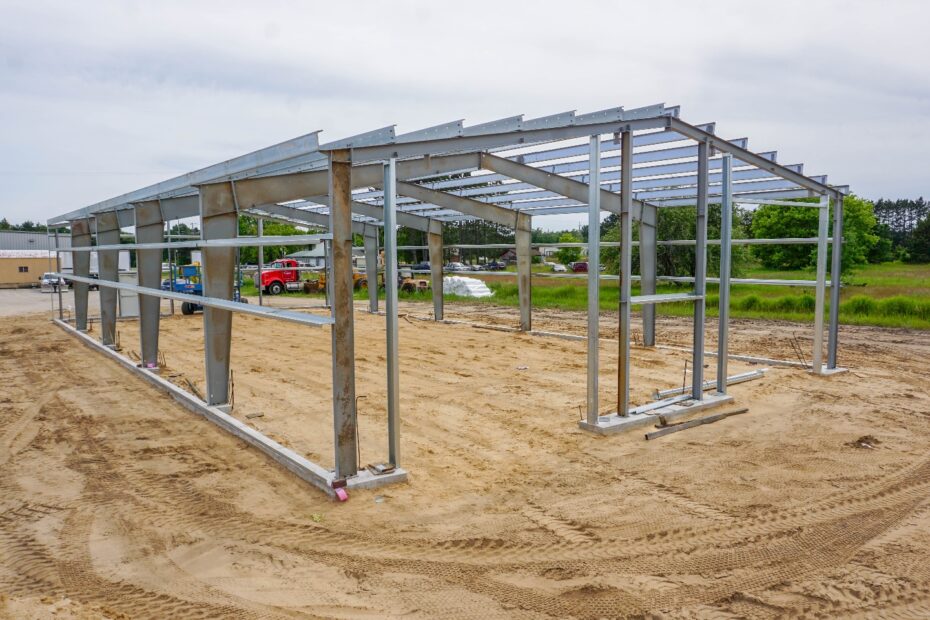
Pre-engineered metal building kits are popular for both commercial and residential purposes, due to their affordability and relatively quick build schedule. However, your budget and schedule can quickly veer off track if you miss one crucial step: obtaining engineered foundation plans.
Most steel building kits don’t include the foundation plans, and for areas like Michigan with a deep frost line, the foundation is critically important to making sure your investment is structurally stable and built to last.
Why Don’t Metal Building Kits Include Foundation Plans?
Many steel buildings are manufactured outside the US, which means foundation engineering is far beyond the scope of their involvement. More local suppliers still need to contend with huge differences in climate, ground conditions, and load conditions across the USA, so there’s no one-size-fits-all solution for engineered steel building foundations. For metal building shell kit suppliers that do employ licensed engineers, it typically doesn’t make sense to employ an engineering staff large enough to maintain licenses in all 50 states.
The foundation that is right for your metal building will depend on:
- Location
- Local building codes
- Soil type
- Building size
- Building weight
- Building loads
- Frost line depth
- Budget
With this in mind, unless your prefab steel building supplier offers engineered foundation plans for your state, you will need to hire a licensed professional engineer for structural foundation plans for your specific building and site.
Do You Need a Licensed Professional Engineer to Design a Foundation for Your Steel Building?
Yes, you absolutely do.
The foundation of any construction project is the basis of its structural integrity, the infrastructure that stabilizes and distributes the weight and load. Without a proper foundation, a building can settle, shift, and crack. This allows water intrusion, rust, mold, and erosion of critical structural components. Improper foundation problems will require cost-intensive and time-intensive repairs.
Avoid all these problems and do it right the first time. Hire a licensed professional engineer to design a foundation plan based on your specific building and site. A structural engineer with experience in metal building foundations understands that the rigid framing and lighter weights of metal buildings can be prone of uplift and lateral forces, which significantly differ from post frame or stick frame buildings. Engineered foundation plans can optimize the design, including enhancements that can improve the long-term durability of your building.
Michigan has heavy snow loads and deep frost line. An adequate foundation is critical to ensuring that your steel building can withstand the harshest winter weather without incurring costly damage.
A licensed engineer will provide you with code-compliant stamped foundation plans. These will ease the permitting process and show the building department that you’ve done your due diligence to ensure your building is structurally sound. At Michigan Building Design, we also make sure our clients know that we support our plans throughout the building process – if you or the local building officials have any questions, we are here to support you.
5 Things You Need to Know for a Stable, Long-Lasting PreFab Metal Building
Pre-engineered steel building kits are an excellent way to add a cost-effective structure to your property, but cutting corners with the building or foundation plans can bust your budget in a hurry. At a minimum, make sure you have taken the following factors into account:
- Load requirements – Metal building designers should account for all the environmental loads for your building based on the location. However, a properly designed foundation is required to support the building itself and transfer those loads into the ground below without adversely effecting the building’s structure. Your engineer-sealed foundation plans will coordinate the column loads with the actual site conditions and regulations.
- Local regulations – Local building code, including frost depth requirements, can affect your foundation design. Your structural engineer will be familiar with the applicable regulations and codes to ensure your foundation plans are code-compliant.
- Site prep is crucial – Metal buildings in particular require extremely level ground. Make sure your site is compacted and level, otherwise you risk anchoring issues, panel misalignment, and water drainage issues which cannot easily be fixed.
- Follow the engineering plans – With structurally engineered foundation plans for your metal building kit, following the plans as written is critical to ensuring the building and foundation perform as designed. If you have any questions or concerns, ask your engineer and they can provide an explanation of the details.
- If you plan to expand the building, make sure that is factored in to the foundation plans. Even if you don’t know when the expansion will happen, certain parts of the foundation may require reinforcement that can’t be easily added later.
Get Affordable Engineered Foundation Plans for Your Metal Building from MBD
At Michigan Building Design, we have the experience and knowledge to provide you with affordable foundation plans for your steel building shell kit. Our team designs using your input, to find a solution that fits your goals.
If you can’t wait to see how a metal building can improve your property or business, talk to Michigan Building Design about foundation plans for the building of your choice. The sooner you have your structurally engineered foundation plans, the sooner you’ll reap the benefits of your new steel building.
To learn more about foundation options for your metal building, or to request a quote, please contact us here. Our team will help you understand what your options are, and how we can help optimize your building for longevity and integrity.